
Reconnect with Yourself.
Restore Your Energy.
Practical tools, thoughtful articles, and guided resources
to help you feel calmer, clearer, and more connected to yourself.
Hi, I'm Yuliya Soldatova, Ia life coach who helps women reconnect with themselves, gain clarity, and move forward with confidence. Through coaching, self-reflection practices, metaphorical cards, karmic numerology, and astrology, I create gentle yet practical tools for deeper self-understanding and meaningful change.
I have nearly 10 years of experience working with people, more than 3,000 hours of consultations in numerology and astrology, and over 100 facilitated transformational games. I am also the creator of three original transformational tools: Flow of Life, My Authenticity, and Chakra Diagnosis.

Why Do I Keep Changing My Mind? 7 Hidden Reasons You Cannot Make a Decision
You make a decision and immediately begin questioning it.
One day, you feel certain that you want change. The next day, staying where you are seems safer. You create a plan, feel excited, and then lose confidence before taking the first real step.
Eventually, the question is no longer only: “What should I choose?”
It becomes: “Why can’t I trust myself?”
Constantly changing your mind can feel frustrating, especially when you are used to being responsible, thoughtful, and capable.
But indecision does not necessarily mean that you are unreliable or do not know yourself.
Often, it means that several different needs, fears, and expectations are competing for your attention at the same time.
Understanding that inner conflict can help you make decisions with greater clarity and less pressure.
1. You Are Trying to Find a Perfect Decision

Some decisions feel difficult because you believe there must be one completely correct answer.
You want a choice that creates no disappointment, carries no risk, and guarantees that you will never regret it.
But most meaningful decisions do not offer certainty.
Every choice creates a direction, and every direction includes both opportunities and limitations.
When you expect a decision to remove all discomfort, you may continue comparing options long after you already have enough information.
Ask yourself:
Am I looking for clarity or complete certainty?
What risk am I trying to eliminate?
What would be a good-enough decision for this stage of my life?
Could I adjust my direction later?
A decision does not always need to be permanent to be valuable.
2. You Are Listening to Too Many Opinions

Advice can be helpful, but too many outside perspectives can make your own voice harder to recognize.
One person tells you to be practical. Another encourages you to take a risk. Someone else believes you should wait.
Each opinion reflects that person’s values, fears, experience, and priorities.
When you repeatedly ask others what they would do, you may begin evaluating your life through standards that do not belong to you.
Ask yourself:
Whose opinion influences me most strongly?
Does this person want the same kind of life I want?
What would I choose without asking anyone else?
Which advice feels supportive, and which creates more confusion?
You can respect another person’s perspective without allowing it to become your decision.
3. You Are Afraid of Disappointing Someone

Sometimes you know what you want, but your choice may affect other people.
You may worry that changing direction will disappoint your family, partner, clients, colleagues, or friends.
You might feel responsible for maintaining stability, meeting expectations, or protecting others from discomfort.
As a result, you alternate between the choice that feels true to you and the choice that keeps everyone else comfortable.
Ask yourself:
Who might be disappointed by my decision?
What am I afraid their disappointment would mean?
Am I responsible for their feelings or only for communicating respectfully?
What am I sacrificing to avoid tension?
Avoiding disappointment does not always preserve a relationship. Sometimes it only postpones an honest conversation.
4. Two Important Needs Are Competing

Indecision often appears when both options meet a genuine need.
You may want freedom and security.
You may want growth and rest.
You may want visibility and privacy.
You may want a new beginning and the comfort of what is familiar.
This does not mean that you are confused. It means that your situation contains a real internal tension.
Instead of forcing yourself to choose one side immediately, identify what each option represents.
Ask yourself:
What need does each choice satisfy?
What am I afraid of losing with each option?
Is there a way to honor both needs?
Could I test one direction without abandoning the other completely?
Sometimes the best decision is not choosing between two needs, but finding a new structure that respects both.
5. You Do Not Trust Your Future Self

You may believe that one wrong decision will create a problem you will not be able to handle.
This makes every choice feel more dangerous than it actually is.
You are not only evaluating the decision. You are also questioning whether you will be capable of responding if circumstances change.
Self-trust does not mean believing that every choice will work perfectly.
It means believing that you can notice, learn, adjust, and make another decision when necessary.
Ask yourself:
What do I believe will happen if this choice does not work?
Have I handled unexpected situations before?
What resources or support would be available to me?
How could I correct the course later?
Your future is not determined by one perfect decision. It is shaped by many decisions, observations, and adjustments.
6. You Are Making Decisions From Temporary Emotions

Your perspective can change significantly depending on your current emotional and physical state.
When you are exhausted, almost every option may feel overwhelming.
When you are inspired, a large change may appear easier than it really is.
When you feel rejected or frustrated, you may want to leave a situation immediately.
Emotions contain useful information, but they do not always provide the full picture.
Ask yourself:
What am I feeling right now?
Is this feeling temporary or part of a repeating pattern?
Would I make the same decision after rest?
What has remained true across different emotional states?
For important decisions, look for what remains consistent after the intensity of the moment has passed.
7. You Are Choosing Between What You Want and What You “Should” Want

Many women reach a point when the life they built no longer fully reflects the person they have become.
On paper, everything may look acceptable.
You may have responsibilities, achievements, relationships, and routines that once made sense.
But internally, something has shifted.
You may feel drawn toward a different direction while simultaneously telling yourself that you should be grateful, practical, patient, or satisfied.
This creates a cycle:
You recognize what you want, judge yourself for wanting it, return to the familiar option, and then feel dissatisfied again.
Ask yourself:
What do I genuinely want?
What do I think I should want?
Where did that expectation come from?
Which choice feels more honest, even if it feels less familiar?
Changing your mind may sometimes be a sign that you have not yet given yourself permission to acknowledge the truth.
A Simple Decision-Clarity Exercise
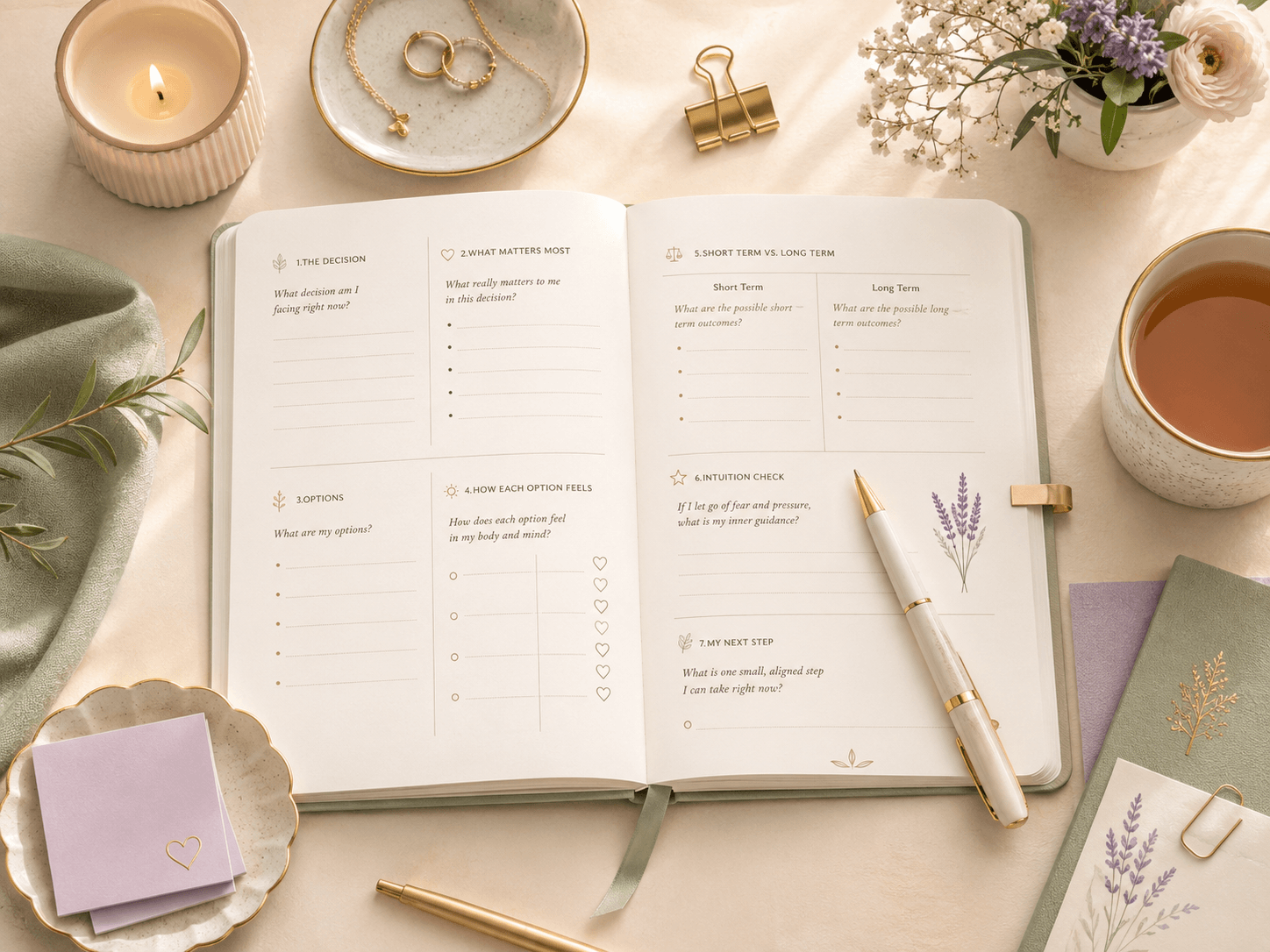
Take a blank page and write the decision at the top.
Then divide the page into four sections.
Option One
Write what this choice gives you, what it requires, and what you may need to release.
Option Two
Do the same for the alternative.
Fear
Write down the outcome you are most afraid of.
Be specific. A clearly named fear is easier to examine than a vague sense of anxiety.
Truth
Complete these sentences:
What I already know is…
What I keep avoiding is…
What matters most to me now is…
The smallest decision I can make today is…
The purpose of this exercise is not to force an immediate answer.
It is to separate your genuine preference from fear, pressure, and other people’s expectations.
Three Questions That Can Simplify Almost Any Decision
When your thoughts become complicated, return to these three questions:
1. Which choice reflects the person I am becoming?
Not the person you used to be or the person others expect you to remain.
2. Which discomfort am I willing to accept?
Every meaningful choice includes some discomfort. The question is which discomfort supports your growth.
3. What would I choose if I trusted myself to handle the outcome?
This question shifts your attention from controlling the future to trusting your ability to respond to it.
You May Not Be Indecisive
You may be trying to make a decision while managing fear, responsibility, expectations, uncertainty, and several important needs at once.
That is not weakness.
It is a sign that the decision matters to you.
But clarity rarely arrives through endless analysis.
At some point, you need to choose the direction that feels most aligned with your present values and allow experience to provide the next piece of information.
You do not need to predict your entire future.
You only need enough clarity for the next honest step.
Continue Your Reflection
MY LIFE RIGHT NOW is a guided printable reflection toolkit designed to help you understand your current situation before making your next decision.
Through metaphorical cards, structured coaching questions, and practical reflection pages, you can explore the needs, fears, patterns, and priorities influencing your choices.
It is not about receiving someone else’s answer.
It is about hearing your own answer more clearly.
Author:
Yuliya Soldatova






TRENDS
7 Self-Reflection Questions to Ask When You Feel Stuck in Life
Seven questions to help you find clarity again.
Quis nostrud exercitation ullamco..
Incididunt ut labore et dolore magna aliqua..

ABOUT ME
I’m Yuliya Soldatova, a life coach helping women gain clarity, reconnect with themselves, and create meaningful change through reflection, coaching, and practical self-discovery tools such as transformation games, metaphorical cards, numerology etc.