
Reconnect with Yourself.
Restore Your Energy.
Practical tools, thoughtful articles, and guided resources
to help you feel calmer, clearer, and more connected to yourself.
Hi, I'm Yuliya Soldatova, Ia life coach who helps women reconnect with themselves, gain clarity, and move forward with confidence. Through coaching, self-reflection practices, metaphorical cards, karmic numerology, and astrology, I create gentle yet practical tools for deeper self-understanding and meaningful change.
I have nearly 10 years of experience working with people, more than 3,000 hours of consultations in numerology and astrology, and over 100 facilitated transformational games. I am also the creator of three original transformational tools: Flow of Life, My Authenticity, and Chakra Diagnosis.

What Is Quietly Draining Your Energy? 7 Hidden Energy Leaks to Notice
Sometimes exhaustion has an obvious explanation.
You have been working too much. You have not slept well. Your schedule has been unusually busy.
But sometimes your life looks relatively normal, and you still feel emotionally tired, mentally overloaded, or disconnected from yourself.
You may wake up without motivation. Small decisions feel heavier than they should. You keep postponing things that matter to you. Even when you have free time, you do not feel genuinely rested.
This does not always mean that you need to become more disciplined or productive.
Sometimes the real problem is that your energy is being spent in places you have stopped noticing.
These hidden energy drains often look harmless from the outside. They can become so familiar that you begin to consider them a normal part of life.
Recognizing them is the first step toward changing them.
Why Hidden Energy Drains Are Difficult to Notice
A hidden energy drain is something that repeatedly consumes your emotional or mental resources without creating meaningful progress, satisfaction, or relief.
It may be a decision you continue to avoid, a commitment you no longer want, a relationship dynamic that requires constant emotional effort, or an expectation you have outgrown. Unlike a major crisis, these drains rarely demand immediate attention.
Instead, they quietly accumulate. One unfinished conversation may not feel significant. One obligation may seem manageable. One ignored need may appear unimportant. But when several of these experiences remain unresolved, they can create a constant background pressure.
You may not be able to name exactly what is wrong, but you can feel that something is taking more from you than it gives.
Here are seven hidden energy drains worth noticing.
1. Decisions You Keep Postponing

An unfinished decision does not disappear simply because you stop actively thinking about it.
Part of your attention remains connected to it.
Should you begin the project? End the commitment? Change direction? Have the conversation? Say yes or say no?
When a decision stays open for weeks or months, it becomes a mental tab that never fully closes.
You may revisit the same thoughts repeatedly without reaching a conclusion. This creates the feeling of being busy internally, even when nothing is visibly happening.
Ask yourself:
What decision have I been avoiding?
What am I afraid might happen if I choose?
What information do I genuinely still need?
What would become easier once this decision was made?
You do not always need complete certainty before moving forward. Sometimes you only need enough clarity to choose the next reasonable step.
2. Saying Yes When You Want to Say No

Every automatic yes has an energetic cost. You may agree because you do not want to disappoint someone, create tension, appear selfish, or explain your real feelings. In the moment, saying yes can feel easier than setting a boundary. Later, however, the resentment, pressure, and emotional resistance begin to appear.
The commitment itself may not be the only drain. A large amount of energy can also be spent judging yourself for not wanting to do it.
Ask yourself:
Where am I agreeing out of guilt rather than genuine willingness?
Which commitment creates resistance every time I think about it?
What boundary would make this situation more sustainable?
What would an honest answer sound like?
A thoughtful no can protect the energy required for the things that truly matter to you.
3. Pretending That Everything Is Fine

It takes energy to hide what you genuinely feel You may continue smiling, helping, working, and taking care of everyone while ignoring your frustration, sadness, disappointment, or uncertainty. You may even tell yourself that your feelings are not important because other people have bigger problems. But emotions do not usually disappear when they are dismissed. They often move into the background and continue influencing your thoughts, reactions, and body. You do not need to dramatize every feeling. You do need to acknowledge what is true.
Ask yourself:
What feeling have I been trying not to feel?
What am I pretending does not bother me?
What would I admit if I did not need to appear strong?
What does this emotion seem to be asking for?
Honesty with yourself does not make you weaker. It reduces the effort required to maintain an appearance that no longer matches your inner experience.
4. Trying to Meet Outdated Expectations

Some expectations once helped you feel safe, accepted, or successful. Be easy to deal with. Stay productive. Finish what you started. Do not change your mind. Put other people first. Be grateful for what you have. But an expectation can remain active long after it stops reflecting who you are. You may continue building a life around an identity you have already outgrown. This creates an exhausting internal conflict: one part of you is ready for change, while another part is still trying to follow old rules.
Ask yourself:
Which version of myself am I still trying to maintain?
What do I believe I should want at this stage of life?
Whose approval am I afraid of losing?
What expectation no longer fits the person I am becoming?
Growth often requires releasing an old definition of who you are supposed to be.
5. Constant Mental and Digital Noise

Not all exhaustion comes from difficult work. Sometimes it comes from never giving your attention enough time to settle.
Messages, notifications, videos, news, unfinished tasks, saved ideas, open browser tabs, and constant switching between activities can keep your mind in a state of low-level stimulation.
Even rest becomes filled with information. You may technically stop working, but your nervous system never receives a clear signal that the day has slowed down.
Ask yourself:
What information am I consuming without intention?
Which digital habits leave me more scattered?
When was the last time I experienced quiet without reaching for my phone?
What could I temporarily mute, close, or remove?
Your attention is a limited resource. Protecting it is an important form of self-care.
6. Tolerating Small Things That Feel Wrong

Energy is often drained through situations that seem too minor to address. A cluttered space. An uncomfortable routine. A task that repeatedly irritates you. A conversation you keep avoiding. A system that no longer works. A promise you no longer want to keep. Individually, these things may appear insignificant. Together, they create friction throughout your day. Each time you encounter the same unresolved irritation, you spend a small amount of emotional energy adapting to it again.
Ask yourself:
What am I tolerating every day?
What repeatedly creates frustration or discomfort?
What have I been telling myself is “not a big deal”?
Which small change would immediately create relief?
You do not have to redesign your entire life. Removing one repeated source of friction can create noticeable space.
7. Rest That Does Not Actually Restore You

Not every break is restorative. Scrolling for an hour, watching several episodes, or lying down while mentally reviewing unfinished tasks may distract you, but it may not replenish you.
Restoration often requires something more intentional: silence, movement, nature, creativity, emotional expression, meaningful conversation, or time without demands. The kind of rest you need may also change depending on the type of exhaustion you are experiencing. Physical tiredness, emotional overload, decision fatigue, and creative depletion do not always require the same response.
Ask yourself:
What kind of exhaustion am I experiencing?
What activities leave me calmer or more alive afterward?
What do I call rest that is actually avoidance?
What would genuine restoration look like today?
Rest is not simply the absence of work. It is an experience that helps you return to yourself.
A Simple Personal Energy Audit
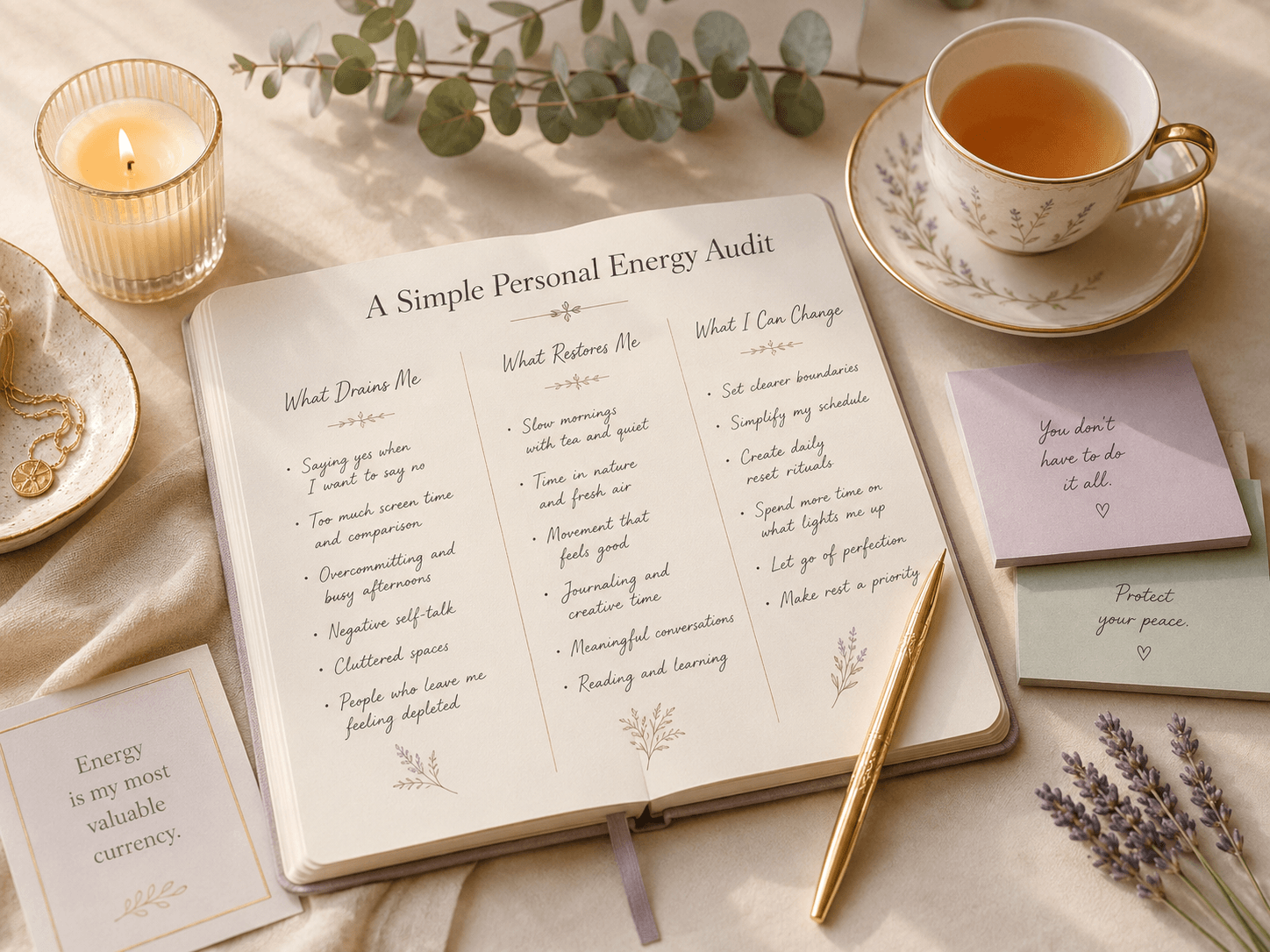
You do not need to fix every energy drain at once.
Begin by observing your current reality without judgment.
Take a piece of paper and divide it into three sections.
What Drains Me
Write down the situations, responsibilities, habits, conversations, and thoughts that consistently leave you feeling heavier.
What Restores Me
List the people, environments, practices, and activities that help you feel calmer, clearer, or more connected to yourself.
What I Can Change
Choose one drain that is currently within your influence.
Your next step might be:
making one decision;
cancelling one unnecessary commitment;
setting one boundary;
closing one unfinished task;
creating one hour without digital noise;
changing one part of your routine;
asking for help.
The goal is not to create a perfectly balanced life. The goal is to notice where your energy is going and decide whether that direction still makes sense.
You May Not Need More Motivation
When you feel stuck, it is easy to assume that you need more motivation, confidence, or discipline. But sometimes you already have enough energy. It is simply being consumed by unresolved decisions, emotional pressure, outdated expectations, and commitments that no longer fit.
Before asking yourself how to do more, ask: What is quietly taking my energy right now?
The answer may reveal the next change more clearly than another productivity plan ever could.
Continue Your Reflection
My Life Right Now is a guided printable reflection toolkit designed to help you look at your current life from a new perspective. Using metaphorical cards, coaching questions, and structured reflection pages, you can explore what is happening beneath the surface, recognize hidden patterns, and choose one practical next step. It is not about predicting the future. It is about seeing your present more clearly.
Author:
Yuliya Soldatova






TRENDS
7 Self-Reflection Questions to Ask When You Feel Stuck in Life
Seven questions to help you find clarity again.
Quis nostrud exercitation ullamco..
Incididunt ut labore et dolore magna aliqua..

ABOUT ME
I’m Yuliya Soldatova, a life coach helping women gain clarity, reconnect with themselves, and create meaningful change through reflection, coaching, and practical self-discovery tools such as transformation games, metaphorical cards, numerology etc.